
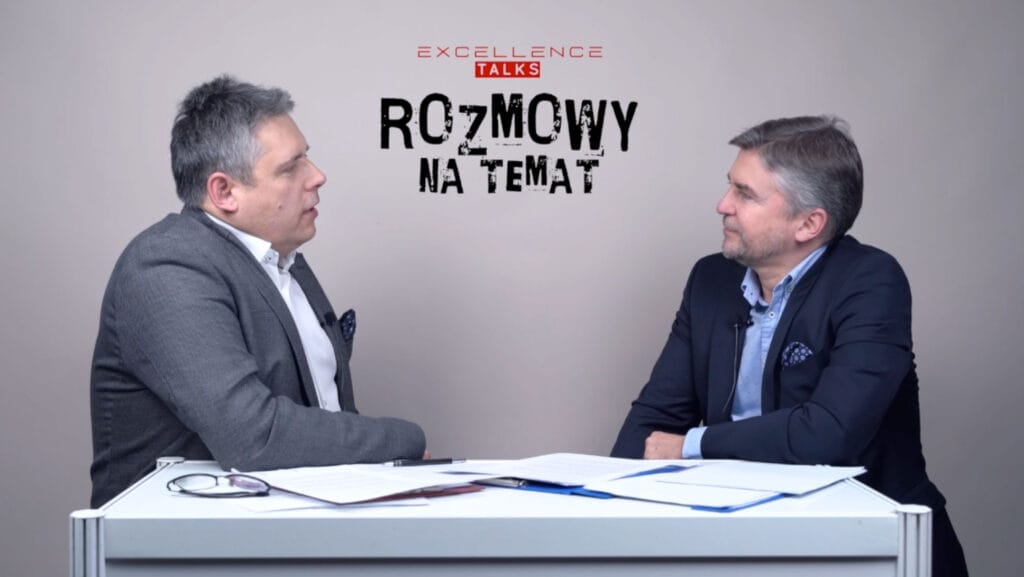
We see three types of clients. Some prioritize pure entertainment and team building—for them, drawing heavy business conclusions takes a backseat. Others want a healthy balance between fun and learning. And then there are those for whom the gameplay is just a pretext to dive straight into hard business matters. The beauty of a strategic game is that it can be seamlessly adapted to fit any of these expectations – says Games4Biz Managing Director PAWEŁ CHABROS
Interviewed by TOMASZ BORG – Partner at Training Excellence
TOMASZ BORG: Paweł, when people hear the word “game,” they think…
PAWEŁ CHABROS: Fun, entertainment…
Exactly. And when they hear “interactive corporate simulation game”?
– That right there highlights that it’s not just about having fun. It’s about interactivity—real, dynamic interaction between the players—and a constant tie-back to actual business realities.
Let’s break down these business games: where does the fun stop and the serious learning actually happen?
– It completely depends on what the client wants to achieve. As I mentioned, some prioritize entertainment and team building, while others want that perfect balance, or look at the game purely as a springboard into hard business metrics. The beauty of a business simulation game is its total flexibility.
What else makes business simulations truly great? What should companies look out for?
– What sets the best business simulations apart is that they draw a sharp line between the actual gameplay and the analysis afterward. This design is a direct nod to David Kolb’s experiential learning cycle. First, you have the raw experience. Then, you step back and reflect on what just happened. After that, you draw your business conclusions, and finally, you figure out exactly how to use those insights in your day-to-day work. Without that clear separation, real learning just doesn’t happen.
Should corporate learning solutions directly replicate the client’s industry reality? For instance, does a pharmaceutical company benefit most from a pharma-themed scenario?
– Absolutely not. In fact, I’d say it’s more of a barrier than an asset. When a scenario is completely detached from their day-to-day industry, it is much easier for participants to break out of those automatic, routine behaviors that block real change. Plus, let’s face it—a fantasy plot or a space expedition is just way more engaging. It triggers real emotions and excitement, whereas rehashing the exact same workplace topics for the hundredth time just puts people to sleep.
That makes perfect sense. But how do you actually make that transition? How do you bridge the gap from an intergalactic journey or the era of North American clans back to the participants’ everyday workplace realities?
– That’s the million-dollar question. The secret lies in using sharp, well-thought-out analogies that connect the game’s storyline directly to real life. For example, when you encounter a meteor shower during your deep-space journey, that might actually be a metaphor for a brutal price war started by a main competitor. Or, if you are playing a historical game, Native American amulets might represent your company’s finite resources. During the debriefing, the facilitator holds up these metaphors and asks the team: ‘How do you handle this exact same scenario at your desk every day?’ That’s when the transition from fantasy to business reality happens instantly.
Does the facilitator actually tell the group how to read these symbols, or do you leave it up to them to connect the dots?
– The beauty of experiential learning is that people live through the experience firsthand, which naturally leads to their own reflections, their own breakthroughs, and ultimately, their own action plans.
So, what’s the facilitators’ true job here? Are they just observing, or is there more to it?
– The facilitator acts as a discussion moderator, not someone who’s there to lead participants by the hand. Let’s face it—these are corporate simulation games for adults. We treat them as professionals, and we fully expect them to think independently, challenge themselves, and draw their own conclusions.
Fair enough, but let’s be real—will adults in serious executive positions actually throw themselves into a game?
– Actually, my experience shows it’s quite the opposite: the higher up someone is in the company hierarchy, the more engaged they get. People in senior positions are usually way more open to trying a fresh, different personal development method. They don’t ‘take offense’ at the game format or think it’s below them. In fact, they jump right in because their natural drive to compete, manage risk, and win takes over within the first ten minutes.
So we know that the first half of the game follows a set storyline. But what about the second part? Is there actually room to tailor the analysis to the client’s everyday business?
– Absolutely. In fact, whenever a client wants to drive serious business results, this second part is always customized 100% to their daily reality. It is a massive, crucial part of the whole process. The game itself stays consistent so the mechanics work perfectly, but the debriefing is completely flexible. We mold it entirely around the client’s actual challenges, turning fantasy scenarios into real-world business plans.
Walk us through it: how do you pull that off, step by step?
– Before the event even starts, the lead facilitator sits down with the client to get a real sense of their company—their goals, how they work, and the specific problems they face day-to-day. This is also when we map out and agree on the business analogies for the game’s symbols. Because of this prep work, when it’s time for the summary, the facilitator speaks the participants’ exact language. They aren’t just using generic corporate jargon. Consequently, the team walks out of the room with a clear list of practical ideas for real changes that they can start putting into action the very next day.
Can you give me some examples?
– Our corporate simulation games hit almost every key business skill you need in a modern company. On the team side, they do wonders for sharpening communication, negotiation, and conflict resolution. They show teams how to solve complex problems together, break down corporate silos, and actually play toward one common goal.
But we don’t stop at soft skills. The simulation forces people to practice high-level strategic thinking, planning, and resource management. Participants learn how to make tough decisions and manage volatility and risk in real-time. It’s basically a stress-test for your entire leadership toolkit.
What is the bottom line here? What makes experiential learning a must-have for modern teams?
– First of all, our simulations are incredibly scalable—you can run them for anything from a small team of 6 people up to a massive group of 200 at the exact same time. This is a huge deal if a company is planning a major event like a large corporate conference, a strategic kick-off meeting, or an annual team retreat, where you need to get everyone fully engaged and working together.
– On top of that, they only take up to 4 hours. This means they are incredibly easy to plug into a busy schedule, fitting smoothly between other presentations or agenda items during a corporate event.
– The games are built on a rock-solid, proven learning model known as Kolb’s experiential learning cycle. This is what guarantees that the training goes way beyond just having fun, turning the experience into a deeply structured and highly effective way to learn.
– Our experiential learning programs tap into the simple fact that people genuinely enjoy learning through play. We all have that inner child that loves a good challenge. When people are having fun and are emotionally invested, they absorb lessons faster, drop their defenses, and walk away way more motivated to actually change their behaviors.
– Let’s face it—gaming is just way more engaging and exciting than listening to traditional speakers drone on with their endless PowerPoint presentations. Instead of sitting there passively watching slides, participants are thrown into the action. It keeps the energy in the room incredibly high because they are the ones making the calls.
– Indoor corporate simulation games are a fantastic alternative to outdoor activities. Let’s be honest—outdoor team-building is always a gamble with the weather, and it takes a ton of logistical planning. Conference room simulations give you that same rush of excitement and team bonding, but everything happens safely indoors, completely rain or shine.
– They are the perfect way to either start or wrap up a major training cycle for a large group. If you use it at the beginning, it’s a brilliant way to break the ice and snap everyone out of their routines to get them ready for learning. If you use it at the very end, it serves as the ultimate finale where the team can finally test out and lock in all the new skills they’ve been practicing throughout the entire cycle.
– And finally, our business simulations have this great flexibility where they can work either as a standalone event or as a key part of a larger one- or two-day training session. This makes it incredibly easy to adapt them to whatever format your company needs.
That’s the ultimate case for corporate simulation games, Paweł. Thank you for sharing your time—it’s been a pleasure!

