
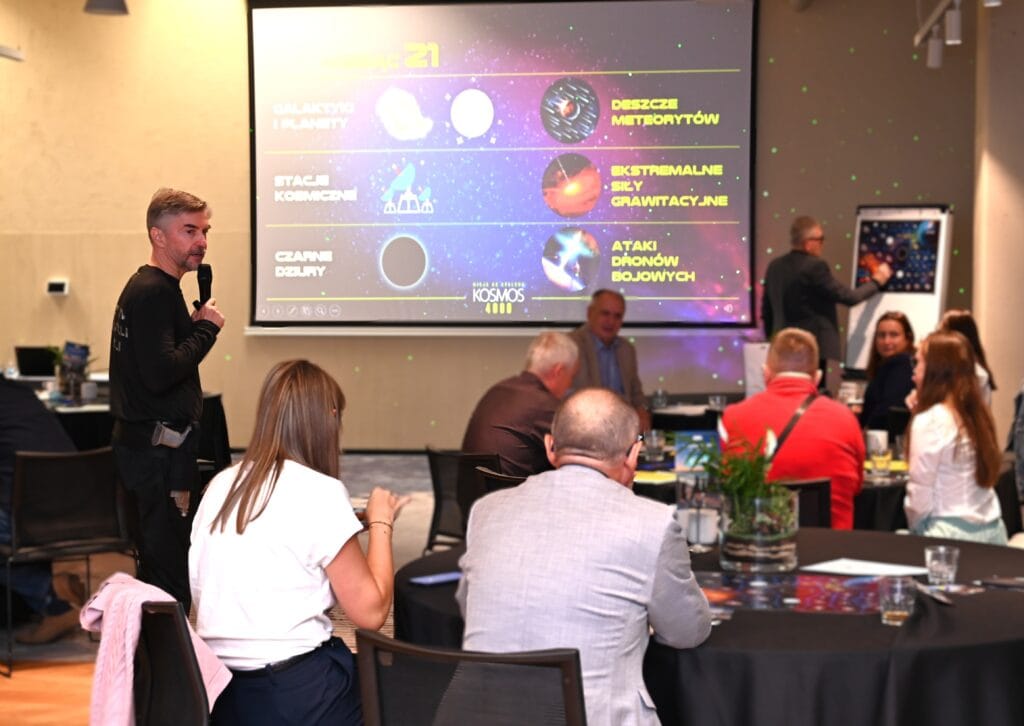
Team building activities are essential for any company aiming for a well-functioning team. However, the nature of team building is rapidly evolving. It no longer serves solely for entertainment and reinforcing bonds, but is closely tied to business objectives. It focuses on measurable outcomes.
Tangible results of team building initiatives
Research shows that companies investing in effective team building programs achieve significantly better results. Businesses that decide to take such a step:
- report 26% higher revenue,
- reduce employee turnover by 50%,
- increase mutual trust among employees by up to 81%.
You might wonder what type of team building delivers this level of return on investment (ROI).
Why corporate simulation games outperform traditional team building events
Traditional synergy-building initiatives often lack the strategic elements that combine engagement with real professional development. Business simulation games change this paradigm by allowing participants to improve essential on-the-job competencies like communication, planning, risk management, and decision-making in real time.
Each game offers a powerful diagnostic opportunity to observe team behavior and extract practical insights that can be directly implemented into real-world business projects.
Corporate simulation games – development through experience
Well-designed business simulations allow participants to better understand their strengths and areas for growth. Joint problem-solving and achieving ambitious goals under intense time pressure perfectly reflect today’s volatile business realities. These experiences foster personal accountability for shared results, transparent communication, cross-functional cooperation despite personality differences, and a creative approach to complex tasks. For this reason, business simulation games are chosen by organizations that want to simultaneously boost team spirit and maximize productivity.
Team building games – more than just fun
While many corporate activities are available on the market, simulation games offer the ultimate balance between entertainment and actionable learning. Each scenario allows participants to test out new leadership roles, develop advanced cooperation skills, and experience the power of collective decision-making. These programs are highly scalable, making them the perfect solution for both global enterprises and agile startups, regardless of industry or group size.
Summary
Effective team building programs must bridge the gap between engagement and practical on-the-job application. Corporate simulation games seamlessly combine emotion, fun, and strategic learning into a single experience. They help elevate team performance, drive better business results, and lower employee turnover.
Companies that opt for professional business simulations gain far more than just connected teams. They build a workforce that cooperates more effectively, resolves conflicts faster, and executes goals more successfully. Best of all, the impact is long-lasting—participants retain the insights gained during the simulation and eagerly apply them to their daily workflows, delivering a real, measurable ROI.
If building a high-performing, aligned organization is one of your top priorities, partner with us to deploy a world-class business simulation today.
Corporate Team Building Games: Premium Scenarios
At Games4Biz, we have developed a curated portfolio of corporate simulation games tailored to diverse organizational needs and group profiles.
- Cosmos 4000. Mission to Avalone – A cinematic, high-stakes space expedition where participants must collaborate to save the planet. This simulation serves as an excellent vehicle for enhancing communication, resource allocation, and strategic planning under intense pressure.
- The Red Cloud Alliance – An immersive historical simulation focused on strategic negotiation and consensus-building. It is the perfect fit for cross-functional teams looking to break down organizational silos, elevate soft skills, and master win-win alignment.

